Multicultural consumer insights from social video: how to define and compare content cohorts
Consumer insights from social video are findings about how specific selected content cohorts talk about a category, product or brand. The cohorts are defined by public content signals: the language and code-switching used in posts, the cultural references people share, the community hashtags they join and the creators who publicly describe themselves as part of a community. They are not representative samples of entire communities, and the method stops short of inferring anything about individuals.
The sections below are the responsible method for building and reading these cohorts.
Why keyword lists struggle to isolate cohorts
A keyword list finds posts that contain your words. A cohort shows up in other ways: a phrase in Spanglish, a spoken joke that only lands in one community, a creator's own framing. If the signal is spoken rather than written, a keyword list finds it only when the pipeline transcribes and indexes speech.
For scoped context on mixed-language speech, Pew Research found that 63% of surveyed US Latino adults say they use Spanglish at least sometimes (40% often). This describes the surveyed adults' self-reported use of Spanglish, not the share of social posts written in Spanglish; the latter is a separate question that requires a content measurement. Either way, a single-language keyword list is a weak fit for mixed-language speech.
Our earlier piece on multilingual social listening covers one Boolean query per language. This piece goes further: cohorts inside one language too, including English-language cohorts such as self-described Gen Z women reviewers.
Defining a cohort without labelling people
Work at the level of public content and self-descriptions, never at the level of inferences about individuals. A cohort is defined by what posters publicly say and share, or by what creators have publicly declared about themselves. It is not defined by their appearance, their name, their voice, or anything else a reader might infer.
Signals you can use
- Language detected on the transcript or post description
- Cultural references people themselves make in the content
- Community hashtags people join
- Topics discussed
- Creators who publicly self-describe their community in their own bio or content (volunteered public descriptions, not researcher labels)
Signals you should not use
- Appearance in the video
- Names
- Accents
- Any inference about a person's identity that is not something they themselves publicly stated
Self-description is a cohort definition, not an identity claim
A creator who publicly describes themselves as "AAPI food creator" has defined themselves on that signal. Using that volunteered public description to assemble a cohort is different from labelling anyone's ethnicity. The cohort includes those creators because they said so, and the aggregate finding is about the content in that cohort, not about any additional characteristic of the people in it. The method note should say so.
Write the cohort definition down before you look at results
Two sentences. What the cohort includes, and the assignment rule when a post could belong to more than one cohort. If you cannot write it before the pull, the cohort is a vibe, not a research object.
For the generational case, see Gen Z video culture vs text tools.
What social video adds
Social video carries what people say out loud, not only what they type. dig transcribes speech in 100+ languages and analyses posts, descriptions and transcripts in their original language. Accuracy varies by language. That means a code-switched review or a spoken cultural reference can be found and read alongside the post description.
Audience reach without overstating it: Pew Research (2025) reports 37% of US adults use TikTok, and White adults are less likely than Black and Hispanic adults to use it. That is a platform-usage figure, not a reason to claim a tool represents a community. For the general case, see why brands need a video-first approach.
Worked example: three cohorts, one snack category, with the overlap counted
Illustrative only, not a dig benchmark.
Fictional brand Tierra Crunch sells a chili-lime snack in the US. An agency defines three cohorts.
- Cohort A. Posts whose detected language is Spanish or mixed Spanish-English, using a set of community hashtags.
- Cohort B. Posts from creators who publicly describe themselves as part of an AAPI food community in their bio or in the post itself.
- Cohort C. English-language posts from a list of creators who publicly describe themselves as Gen Z women snack reviewers.
Over 90 days the project finds 3,000 posts about the category. Assignment rule: a post that fits more than one cohort is counted in each cohort where it fits (non-exclusive). The overlap is reported, and the overall unique-post total reconciles to 3,000.
Reconciliation to 3,000 unique posts. Sum of cohort counts: 900 + 600 + 1,000 = 2,500. Overlap pairs are A-B (60 posts) and B-C (20 posts); there is no three-way overlap and no A-C overlap in this dataset. Each overlap post was counted twice in the cohort sum (once per cohort it fit), so unique in-cohort posts = 2,500 − 60 − 20 = 2,420. Unique in-cohort posts (2,420) + posts outside all three cohorts (580) = 3,000.
What each cohort talked about (as cohort-level content findings, not community-level claims)
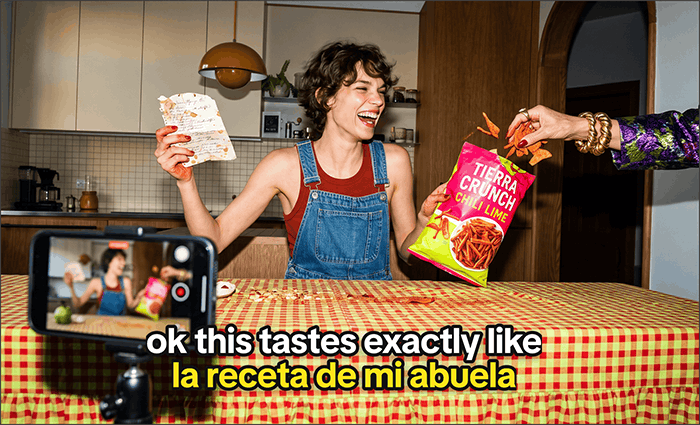
- Cohort A posts most often compared the flavour to a family recipe.
- Cohort B posts most often paired it with other snacks in side-by-side taste tests.
- Cohort C posts most often debated whether it is "too spicy for work."
Those are findings about the content in each selected cohort. They are not findings about the Spanish-speaking US population, the AAPI population, or Gen Z women as a whole. The method note states this plainly.
Non-English example lines go to a local reviewer before anything is presented. Translation is not neutral: a word that reads flat in English can land differently in the original, and vice versa. The reviewer catches the mistake before it reaches a client room.
English is not culturally neutral
Cohort C is English-language. That does not make it the "default" or "neutral" cohort. English-language content from Gen Z women snack reviewers has its own culture of reference, humour and in-group signals, and findings from it need the same review discipline the Spanish and AAPI cohorts get. The default to review non-English content and not English content is itself a bias worth naming.
Avoiding over-reading a cohort
Treat each cohort read as evidence from that cohort, not proof about a community.
Sufficiency depends on the question, not a universal threshold
How many posts and creators you need before reporting a finding depends on the diversity of posts in the cohort, how often a theme recurs, the question being asked, and how strong a conclusion you want to draw. A "detectable recurring theme" needs less than "a statement about relative prevalence between cohorts." Set the sufficiency rule for the specific question, written down before the read.
Meaningful discussion vs incidental appearances
A video where the category appears in the background for two seconds is not a vote. A video where the creator reviews the product for a minute is. Separate the two counts.
Local review for non-English and culturally specific examples
Translation accuracy is not the same as cultural accuracy. Both matter and only one is a model problem.
Turning a cohort read into a brief
Write one line per cohort: what they talk about, the words they use, what they praise and what they complain about, with two or three example posts each. Then name one action per cohort, such as a creator brief, a product question or a message to test.
Close with the overlap report so the client sees which posts spoke to more than one cohort at once. Those are often the most interesting.
For what sits in the dark when you read only text, see shrinking the dark.
Pro tip
Define the cohort by what people publicly say and share. Report findings about the cohort, not about the community.
Key takeaways
- Cohorts are defined by public content signals and volunteered public self-descriptions, not inferences about identity.
- A post that fits more than one cohort needs an assignment rule stated in the method note; report the overlap.
- Social video adds spoken content; dig transcribes in 100+ languages, with accuracy varying by language.
- Findings are about the content in the selected cohorts, not about whole communities.
- Sufficiency (how much is enough) depends on the question; no universal post-count threshold.
- English-language cohorts need the same review discipline as non-English.
Frequently asked questions
What are multicultural consumer insights?
They are findings about how specific content cohorts talk about a category, product or brand. In social video the cohorts are defined by public signals such as language, cultural references, community hashtags and self-described creators, and the findings are about the cohort, not about any whole community.
Can social listening identify someone's ethnicity?
It should not try to. Responsible cohort work never infers an individual's ethnicity, race or identity. Cohorts are defined by public content signals and by volunteered public self-descriptions; findings are reported in aggregate about the content.
Why use social video for consumer insights instead of text posts alone?
Video carries spoken reviews, jokes and code-switching that may not appear in the caption. Reading transcripts alongside post descriptions gives a fuller picture of how a cohort talks about a product.
Related stories