Multilingual social listening without a Boolean query per language

A creator in Riyadh says your product's name out loud, switches to English halfway through a sentence and captions the clip in Latin-letter Arabic. A keyword list translated into Arabic script can miss spoken names, mixed-language phrasing and Latin-script Arabic. Multilingual social listening tracks a brand across languages, dialects, scripts and speech in one program, built on one shared brief with locally validated coverage.
If you run listening for more than one market, you probably know the routine already. Someone writes the English query, someone else translates it, and a few months later each market's version has drifted in its own direction, kept alive by whoever in the local team still knows the syntax. Coverage ends up uneven between markets, and nobody can say by how much, which is the part that should worry a regional lead most.
What is multilingual social listening?
Multilingual social listening is a single listening program that collects and analyses posts in the languages your markets use, including dialects, mixed-language posts, transliterated script and spoken audio in video. Report against a shared taxonomy, then check coverage and classification quality in each market before comparing results. Allow local subtopics where meanings differ.
A shared taxonomy aligns the categories, so a team in Riyadh and a team in Mexico City are using the same names for the same narratives. It doesn't remove differences in collection coverage, platform use, sampling or classification quality between markets, and those are what a regional lead has to rule out before reading a difference as real. It belongs to the wider practice of social intelligence, and if you want the longer version of what social intelligence is and is not, start there.
Why does translating a Boolean query fail across markets?
A Boolean query is a guess about the exact words people will use. Translating it carries that guess into a language where people pick different words, spellings and scripts. The result is one query per market, each drifting on its own, missing dialect and slang, and needing a native speaker to keep it current.
Multiply that by every product line and every market and the setup becomes the job. The drift also doesn't show up on a dashboard, since a market with a weaker query simply returns fewer posts, which reads as quieter conversation. We've written separately about the problem with Boolean queries in social listening, so the short version here is that language multiplies a problem the query already had.
Is Arabic one language or many for social listening?
For listening purposes, plan for many. The ISO 639 standard classes Arabic as a macrolanguage, and Ethnologue lists 28 individual varieties under it. Arabic social posts can use dialect, Modern Standard Arabic or a mixture, and because varieties share much vocabulary while differing in everyday words, a query written in one variety can under-collect the others.
Example: the everyday greeting how are you is kayfa haluka in Modern Standard Arabic, ezzayak in Egyptian Arabic and shlonak in Gulf and Iraqi Arabic. A keyword list built from one of these finds one community's casual conversation and misses the rest, and the same holds for any brand nickname or product slang that grew up locally. A survey of automatic Arabic dialect identification describes how closely related the varieties are, which is exactly why a keyword list struggles to separate them.
Languages, dialects and markets
Plan with three levels in mind, the language, the dialect or variety, and the market where the audience lives. A single country can span several varieties, and one dialect can cross several borders, so a market rarely maps onto one language setting. The market level matters most for audiences such as US Hispanic consumers, many of whom speak both English and Spanish, and whom no language setting can isolate on its own.
How do code-switching and transliteration break keyword lists?
Code-switching is moving between two languages in one post, as in Spanglish or Hinglish. Transliteration is writing a language in another script, as in Arabizi, which writes Arabic in Latin letters with numbers for some sounds. Both put the brand talk outside any single-language keyword list, and both are common on social platforms.
Code-switching in Spanglish and Hinglish
Mixed-language posts are hard enough that researchers built a shared benchmark around them. In the SemEval-2020 task on sentiment in code-mixed tweets, which covered Hinglish and Spanglish, the best systems reached an F1 score of 75.0% for Hinglish and 80.6% for Spanglish, where F1 balances how much a system catches against how often it's right. Those were the top scores in that 2020 shared task, and they're a fair reminder to ask any platform what happens to a sentence that changes language halfway through.
Transliteration in Arabizi and romanised Hindi
In Arabizi, the digit 3 stands for the letter ain and 7 for haa, so one word can be spelled several ways without a single Arabic character. When researchers studied code-switching in Arabizi social posts, they found Roman-script Arabic mixed with English, French and Arabic script inside the same posts. Romanised Hindi has the same effect, and a query written only in Arabic script or Devanagari won't match either one.
Why does spoken language matter in social video?
In video, a lot of brand talk is said rather than written, and the spoken layer is where dialect, code-switching and a product name said out loud tend to sit. A post description often carries none of it. Transcripts recover that layer, though speech recognition can stumble on accents and dialects, so spoken detections deserve a local reviewer's check.
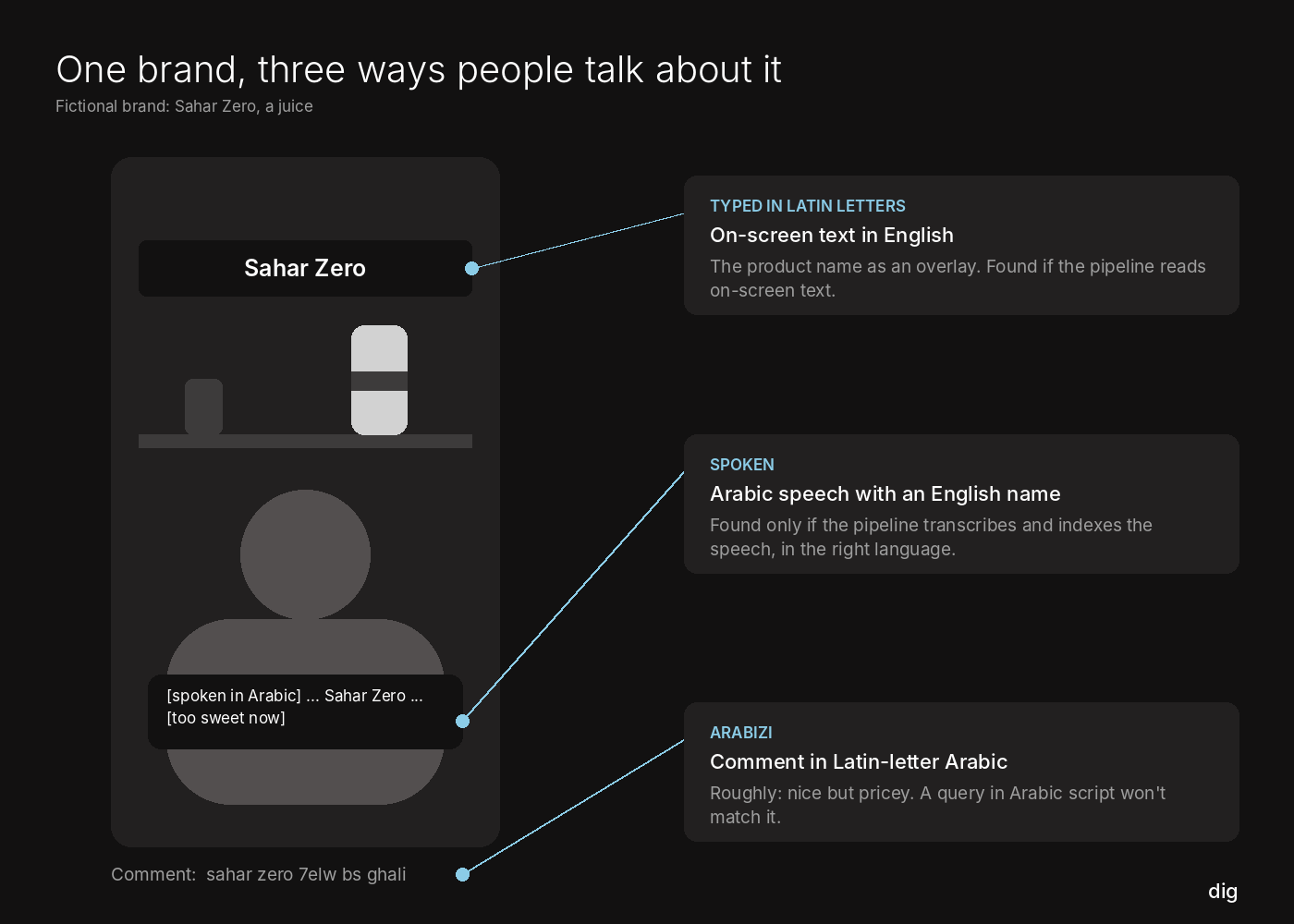
Example: take a fictional juice brand whose product is called Sahar Zero, and three posts about it from the same week in Riyadh. In the first, a creator reviews it on camera in Arabic, says the English product name mid-sentence and calls the new recipe too sweet, while the description reads only "new drink". In the second, a text post in Arabizi reads "sahar zero 7elw bs ghali", roughly "Sahar Zero is nice but pricey". In the third, an English-language post compares Sahar Zero with a competitor. A query in Arabic script finds none of them. A query for the English name finds the two posts that type it. It finds the spoken review only if the pipeline transcribes and indexes that speech. A program that reads speech, Arabizi and English together can put all three in front of the same reviewer.
YouTube's own help page notes that automatic captions may misrepresent the spoken content "due to mispronunciations, accents, dialects, or background noise," which is why the reviewer step matters as much as the transcript.
dig is built for reading what is said and shown inside a video. It transcribes speech in 100+ languages and analyses posts, descriptions and transcripts in their original language, with every insight traced back to the source video so a local team can check any finding against the clip it came from. Accuracy varies by language, which is one more reason to validate each market locally, because the person who can judge a joke in a local dialect is rarely the person reading the dashboard.
What should you require from a multilingual social listening platform?
Test whether the system preserves meaning across dialect, slang and mixed-language examples, whatever processing approach it uses. Check speech and on-screen text in local languages, market segmentation that works separately from language, a shared taxonomy with room for local subtopics, and evidence you can trace to the source post. Score each claim on your own posts.
A supported-languages count is the easiest number to compare across social listening platforms, and it tells you the least about any of the requirements above, since a language count says nothing about whether transcription, text analysis and on-screen text work equally well in each language. The table below turns each requirement into a test you can run in a trial. Keep two kinds of test apart. For analysis, supply known posts and compare results with labels withheld until scoring. For discovery, check whether independently identified, in-scope posts entered the collection without supplying their links first.
A platform can pass a test in English and fail the same test in an Arabic dialect, so run every test per market.
How do you set up one listening program across markets?
Start from a list of markets, languages, dialects and scripts, describe the topic once in plain language, and include spoken audio and on-screen text. Before you trust the numbers, have a local reviewer check relevance and coverage in each market. Then report against a shared taxonomy, with local subtopics where meanings differ.
- List each market's languages, dialects and scripts. For Saudi Arabia, that might include several regional varieties of Arabic written in Arabic script and in Arabizi, with English mixed in. Have a local reviewer confirm the list.
- Describe the topic once, in plain language. Cover the brand, products, nicknames, competitors and themes in a short brief that every market can use.
- Include spoken audio and on-screen text for every market, so video where the brand is only said or shown is in scope.
- Estimate relevance per market. Have a local reviewer read a random sample of 50 collected posts per market and label each one relevant or off-topic. That estimates relevance within the sample. It can't show what's missing.
- Check for misses with a reference set. Keep a separate set of in-scope posts each reviewer found independently, and check whether they entered the collection. This checks discovery against your reference set. It does not estimate recall across the whole market. Record the collection deadline before scoring a post as missed.
- Report against a shared taxonomy, check coverage and classification quality in each market before comparing, and allow local subtopics where meanings differ.
- Re-check samples monthly with local reviewers, since slang and spellings keep moving.
Example: a beverage brand covers Saudi Arabia, Egypt, Mexico and US Hispanic audiences. Each month, a local reviewer in each market labels a random sample of 50 collected posts, 200 in total, which gives an estimate of relevance per market. Separately, each reviewer keeps a reference set of in-scope posts found through their own searches, and a post counts as missed when it's in that set and not in the collection. The team writes both rules down before the first review.
Once coverage and classification quality have been checked in each market, you can put them side by side, and that's what makes benchmarking brand perception across markets meaningful. The monthly re-check is also the cheapest way to catch a market that's slowly falling behind, and reviews tend to get quicker once reviewers know which spellings and slang to look for.
The bigger picture
If you work across markets, you already plan for each one's culture, and listening has to plan for each one's way of writing and talking too. A program built on translated queries hands a regional lead numbers that differ for reasons nobody can trace, which is a hard thing to defend in a quarterly review. One shared brief with locally validated coverage keeps the setup simple without pretending local language expertise is optional. Whether your setup uses queries or a shared brief, validate it locally before treating differences in the dashboard as differences between markets.
Key takeaways
- One shared brief, locally validated coverage. Describe the topic once, report against a shared taxonomy, and check coverage and classification quality in each market before comparing.
- Translated queries drift apart over time. Translating a Boolean query copies its guesses into a new language and leaves coverage uneven between markets.
- Dialects, code-switching and Arabizi need their own tests. Arabic is a macrolanguage with 28 varieties listed by Ethnologue, and mixed-language and transliterated posts sit outside single-language keyword lists.
- Test analysis and discovery separately. Supplied posts show how a platform analyses. Independently found posts show whether it would have found them.
FAQs
Can you do social listening in Arabic dialects?
Yes, but test it per dialect. Arabic social posts can use dialect, Modern Standard Arabic or a mixture, so supply posts in each dialect you need, such as Gulf, Egyptian and Levantine, plus Arabizi, and score the results with a local reviewer. Then check discovery against posts found independently.
Should you translate social posts into English before analysing them?
What matters is whether meaning survives. Some systems translate first and others analyse the original language, so test whether slang, dialect and tone come through on your own mixed-language examples, scored by a native reviewer. Translate the findings and example posts for stakeholders once the analysis is done.
How do you track a brand across several languages without separate queries?
Describe the brand, products and topics once in plain language, and use a platform that works from that brief across languages, including spoken audio and on-screen text in video. Then have local reviewers check relevance and coverage per market before you compare markets on a shared taxonomy.

Related stories