How to monitor a brand whose name is a common word

Set a keyword alert for a brand named after a fruit and by lunchtime the feed is all smoothie recipes. Online brand monitoring for a common-word brand name has to decide relevance from context. That means what is said, shown and written inside the video, who posted it and what sits next to the name, with precision checked every week.
Is "Apple" the fruit or the company? A person knows in a second from everything around the word, while a keyword query matches both and leaves you to sort them by hand. Here's how to set up monitoring that makes that call the way a person would, and how to show your stakeholders that it works.
Why do common-word brand names flood monitoring results?
A keyword match has no idea which meaning is in play. If your brand shares its name with a fruit, a first name or a city, every recipe, birthday and weather post matches the query. The result is a feed where relevant mentions are a small minority and the posts you need are hard to find.
Teams usually try to patch this with exclusions, and the query keeps growing until it turns into what one buyer called "clunky, heavy Boolean to get simple answers". In prospect conversations, keyword-only setups returned a tiny share of relevant results, which means most of the team's reading time goes to posts about something else entirely. Each new exclusion fixes one collision and can drop a few real mentions along with it.
Why Boolean queries break down in social listening covers the general limits of exclusion-heavy queries. Telling your brand apart from the everyday word is a narrower job, and it needs its own method, starting with knowing what kind of collision you have.
What kinds of brand-name collisions are there?
The 5 common types are common nouns, people's names, places, acronyms and product category words. Each one collides with a different kind of everyday conversation, so each needs different context to resolve. Knowing which type you have tells you which terms to watch for and which signals inside the video help settle relevance.
A brand-name collision is when a brand shares its name with an everyday word, person, place or acronym, so keyword matches return unrelated posts. The product category word is the hardest case, because the irrelevant posts are about the right topic and use the same vocabulary as real mentions. Visual and spoken context does a lot of the work there, since the logo, the packaging and the creator saying the full name are often what help separate your product from the category.
Where does the context that settles relevance sit?
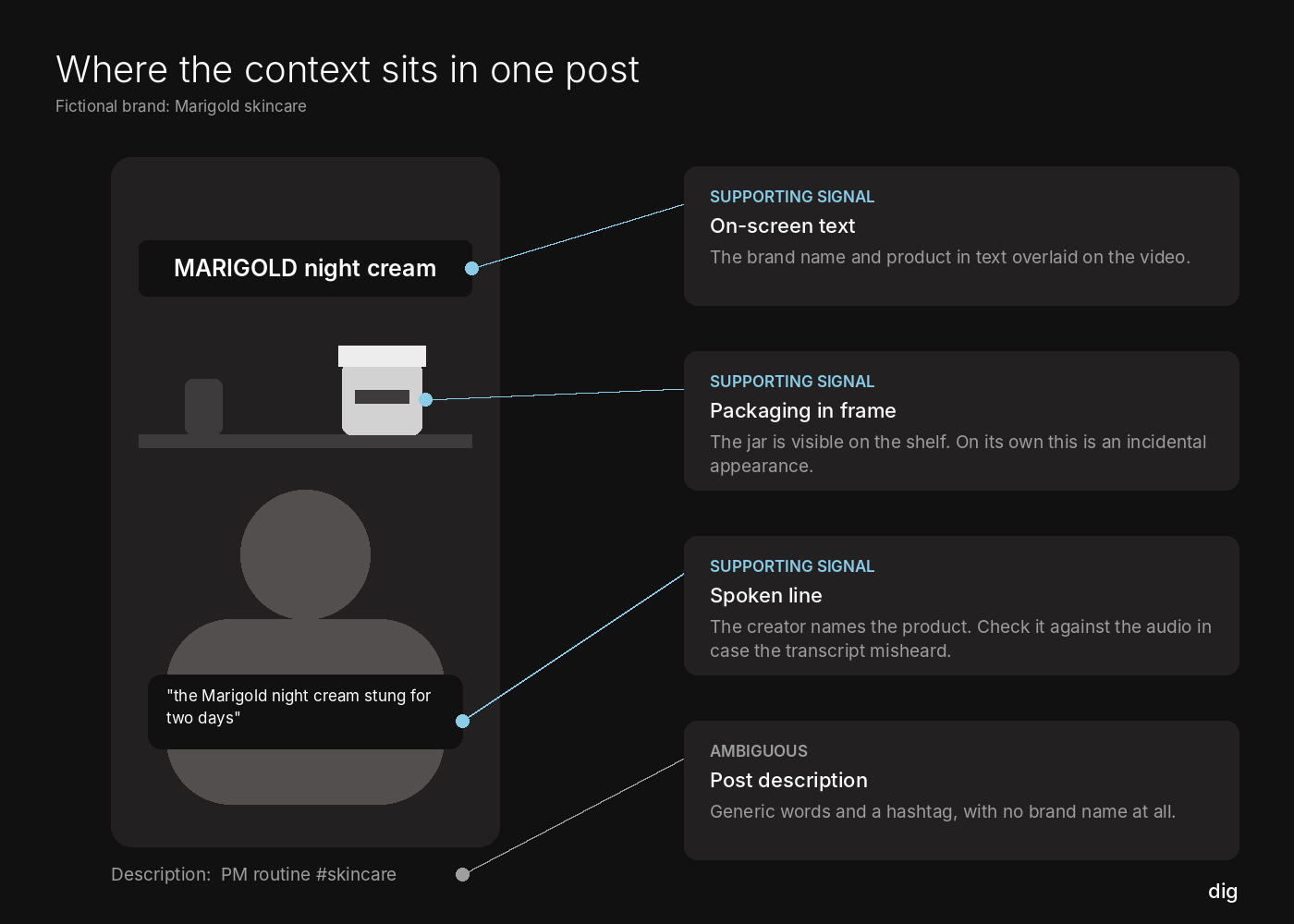
In social video, much of it sits outside the post description. A creator may say the brand name aloud, show the packaging or put the name in on-screen text while the description says something generic. Reading spoken audio, on-screen text and what is visible in frame gives a monitoring setup the context a person would use to judge relevance.
Post descriptions may omit the context spoken inside a video. Transcripts can recover that context, but speech recognition can also mishear brand names, especially one that sounds like an everyday word. Check ambiguous detections against the audio and visual evidence.
Here's how that plays out for a fictional skincare brand called Marigold. A gardening video with the description "my marigold bed is finally blooming" matches the keyword and has nothing to do with the brand, so it's irrelevant. A night-routine video with the description "PM routine" never types the name, but the creator says "the Marigold night cream stung for two days", which makes it a relevant spoken mention you would only find in the transcript, and worth checking against the audio in case the speech recognition misheard. And a get-ready-for-work video with a Marigold jar sitting on the bathroom shelf behind the creator is a visual-only appearance that nobody discusses, so it belongs in your data labeled as an incidental appearance rather than counted as brand discussion.
This is the layer described in how in-video analysis reads what is said, shown and written, and it's why tracking brand mentions across video and podcasts needs audio in the loop. The description can be the vaguest part of the post, a few words and a hashtag, while the creator names the product out loud and holds it up to the camera. A setup that hears and sees the post has the same evidence a person scrolling past it would.
How do you set up monitoring for a common-word brand name?
Write a context profile, build a list of colliding terms from a real sample, use context signals from inside the video, then run a relevance check on a random sample. Track precision weekly and refresh the term list when a new collision appears, such as a film or song that shares your name. The last 2 steps repeat every week.
Step 1. Write a context profile of the brand
List the category, product names, sub-brands, spokespeople, official handles, stores and competitors. This is the vocabulary a relevant post tends to sit near. It also becomes the plain-language description you give an AI-led tool, which is a lot easier to keep current than a long query.
Step 2. Build a negative terms list from a real sample
Pull 100 posts that match the name and read every one of them. Group the irrelevant ones by meaning, such as recipes, birthdays or weather, and write the negative terms from those groups, adding any you expect to see so long as you validate them against the next sample. Be careful with blanket exclusions for travel, weather or family terms, because a genuine brand complaint can contain those words, so use them to flag posts for review rather than drop them outright.
Step 3. Add context signals from inside the video
Use supporting signals, such as the product or logo in frame, a product name spoken, on-screen text in brand styling or the official handle tagged, to assess whether the post concerns your brand. Label uncertain cases for review, and distinguish meaningful discussion from incidental appearances. Keep posts where the brand is shown but never named, and reach them through a tool that reads the frame, or a second route in through your tagged handle and the creators you already know post about you.
Step 4. Sample a relevance check
Each week, take a random sample of 100 posts from the results and label each one relevant or not, deciding in advance how you'll label a product sitting in the background of an unrelated video. Example: if 88 of 100 sampled posts are relevant, precision is 88%, because precision is relevant posts collected divided by posts collected. Then sample posts your rules excluded to identify relevant posts being filtered out, and report the sample size and the relevant share. Separately, check known brand posts, such as your own uploads or videos from creators you work with, that never entered the collection, since an excluded sample can't show you posts the pipeline never picked up.
Step 5. Track precision over time
Chart weekly precision next to the percentage of the excluded sample you found relevant. If you prefer raw counts, keep the excluded sample the same size every week so the numbers stay comparable. A sudden drop in precision usually means a new collision, such as a product launch, a viral meme or a namesake in the news, so update the term list and re-check the following week.
How do you know your monitoring is accurate?
Precision tells you what share of collected posts are about the brand. A sample of excluded posts shows whether your rules are filtering out relevant ones, and a check of known brand posts shows whether they were collected at all, so all three belong in a weekly report. When you compare tools or online brand monitoring services, judge them on your own examples rather than on a headline figure.
Here's the uncomfortable part. A precision number that nobody outside the social team has seen won't help much when a spike lands and someone senior asks whether it's about you. Test dig on your own ambiguous examples, including unrelated uses of the name and videos where the brand appears without being named. Compare detections, misses and supporting evidence, with every insight traced back to the source video.
With ask-dig, a team can ask in plain language whether a spike is really about them and get an answer in under two minutes. That's useful on the day a namesake trends, when the feed fills up fast and the comms team wants an answer before anyone reacts in public. For a manual alternative and where it falls short, see what manual TikTok scrolling misses.
The bigger picture
A brand with a common-word name won't get a clean feed from the name alone, because the everyday word keeps picking up new uses, a film one month and a meme the next. That makes relevance a number to track, the same way you'd track reach or sentiment, with a sample behind it and a trend line other people can check. Treat relevance as a setting you configure once and the feed drifts back to recipes and birthdays. Treat it as a number you check every week and you'll know what your brand data is worth before anyone asks.
Key takeaways
- Keyword matches can't tell a brand from the word. Common-word brands drown in irrelevant results until relevance is judged from context in the post.
- Collision type decides the fix. Common nouns, people's names, places, acronyms and product category words each need different context to resolve.
- Context signals are evidence, not proof. Spoken audio, on-screen text and what's in frame help settle questions the description leaves open, and uncertain cases go to review.
- Measure relevance weekly. Check precision on a random sample of 100 posts, report the relevant share of an excluded sample, and check known brand posts that were never collected.
FAQs
How do I reduce irrelevant results when my brand name is a common word?
Read 100 matching posts, group the irrelevant ones by meaning and write negative terms from those groups. Then use supporting signals, such as the product in frame or a product name spoken, to judge relevance, and send uncertain cases to review. Check precision weekly on a fresh random sample.
Are negative keywords enough to filter brand-name collisions?
Rarely. Negative keywords remove the collisions you predicted, but new ones appear with every film, meme or namesake in the news, and the hardest cases use the same words as real mentions. Pair negatives with context from inside the video and a weekly relevance check.
How do I measure accuracy in brand monitoring?
Take a random sample of 100 collected posts and label each one relevant or not. The relevant share is your precision. Then sample posts your rules excluded and report the relevant share, and separately check known brand posts that never entered the collection.
- Precision: relevant posts collected divided by posts collected.
- Filtered-out mentions: the share of the excluded sample found relevant, reported with the sample size.