
When After-Hours TikTok Scrolling Becomes a Core Business Process

What You Will Learn
- How "Shadow Departments" form when manual labor replaces automated social media monitoring.
- The limitations of human scrolling in capturing high-volume TikTok trends and brand mentions.
- The data gap between manual observation and scalable consumer insights.
- How to reclaim bandwidth by implementing professional tracking.
The Rise of the Shadow Department: The Cost of Manual Monitoring
Have you ever caught yourself doom-scrolling TikTok at night, telling yourself it’s “just to see if anyone mentioned our brand”? That moment is the birth of what is known as ‘the Shadow Department’. Without realizing it, Brand Managers and Social Media Leads start performing manual social media monitoring as an unofficial part of their job - checking comments, scanning videos, and hoping the algorithm comes up with something, hopefully positive. What feels like a quick pulse check slowly turns into a recurring, after-hours responsibility - hence the name: the Shadow Department.
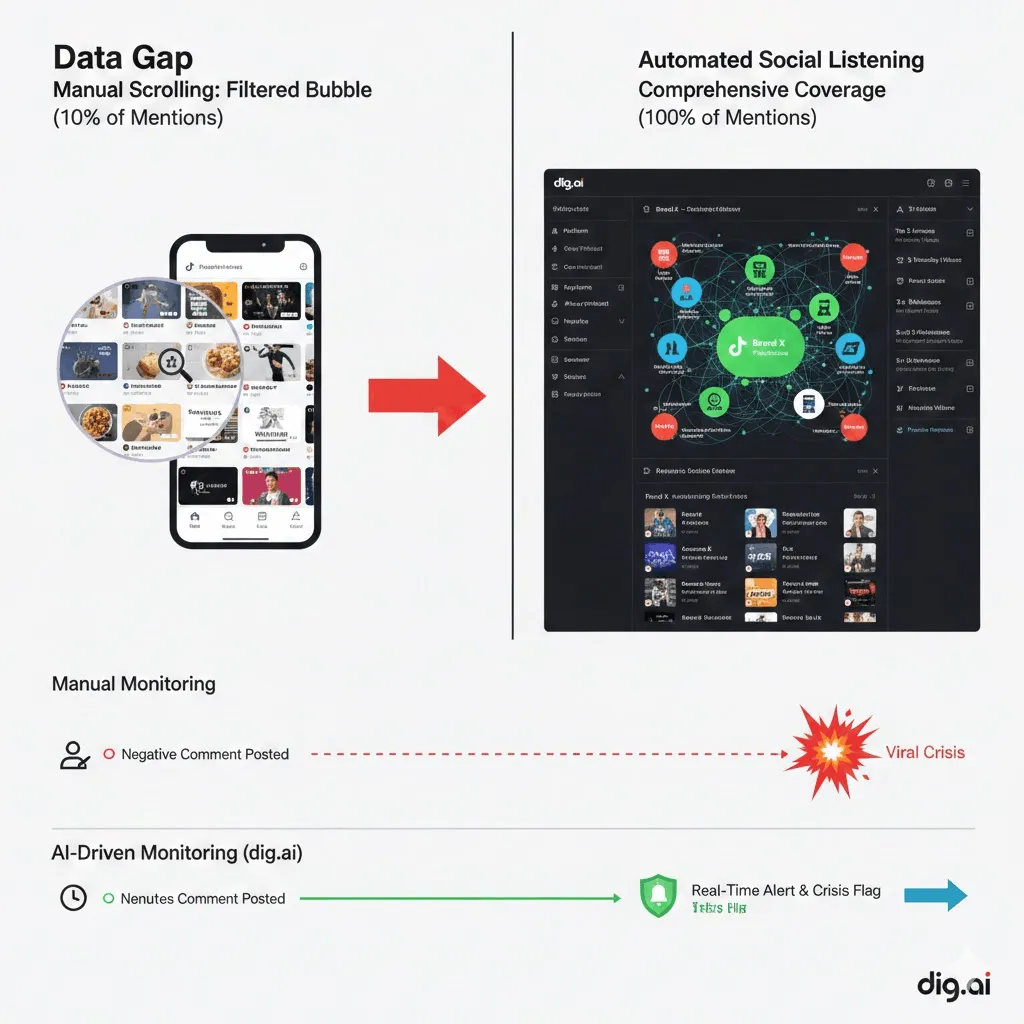
The problem is that this method is fundamentally flawed. Your feed is not a neutral data source; it’s a reflection of your personal viewing history, preferences, and past interactions. TikTok’s algorithm (as well as Instagram’s and any other social network) is optimized for engagement, not for coverage monitoring of brand mentions or emerging risks. When manual scrolling becomes your primary monitoring method, you’re not observing the market - you’re observing a personalized version of it, filtered through entertainment logic rather than strategic relevance.
Over time, this creates both blind spots and burnout. Critical signals may never appear in your feed, while your team spends hours performing repetitive, low-leverage tasks that don’t scale. And the worst part? It drains senior talent, fragments insights, and leaves the brand exposed to conversations happening just outside the algorithmic bubble.
The dig tip:
Run a quick audit: ask three different team members to search for your brand on TikTok from their personal accounts and compare the results. If each feed surfaces different videos, you’re not running social media monitoring - you’re relying on three different algorithms to define your brand reality.
Why Your Brand Can’t "Scroll" Its Way to High-Value Consumer Insights
The shift from “scrolling” to “strategy” isn’t just about efficiency - It’s about perspective. A single feed, no matter how attentive you are, can’t represent the full complexity of social discourse around your brand. What feels like staying close to the users or ‘plugged in’ with the audience, is often a narrow, distorted lens shaped by platform logic rather than market reality. Social listening tools exist precisely to replace this fragmented observation with a comprehensive, data-driven view of consumer sentiment and behavior.
The Algorithmic Blind Spot of Manual Discovery
Manual discovery is inherently biased by the platform's recommendation engine. When a Communications Lead searches for brand mentions on their personal device, they are not seeing an objective sample of conversations - they are seeing a curated slice filtered through their own viewing patterns. This creates an algorithmic blind spot: insights become skewed toward familiar content types, geographies, and audience segments. Left unchecked, it widens into the brand research blind spot that quietly costs market share. High-value consumer insights require an objective, unfiltered data stream that bypasses individual profiles and reveals the full scope of global sentiment and emerging narratives.
Turning Video Noise into Actionable Data Points
Short-form video platforms such as TikTok and Instagram are high-noise environments where trends evolve by the hour and meaning is often conveyed visually rather than verbally. Manually watching dozens or hundreds of clips to extract one relevant signal is not insight generation - it’s manual labor, and it can be exhausting. Professional social media monitoring tools that offer in-video analysis convert this unstructured video stream into categorized, searchable intelligence. Instead of collecting a list of “interesting mentions,” teams gain structured visibility into recurring complaints, emerging use cases, sentiment shifts, and real-time competitive positioning.
Why 50+ TikTok Scrolling for Business Searches Signal a Shift
Search behavior tells a revealing story. Queries around using TikTok scrolling as a business practice are relatively niche, but they point to a growing recognition among Consumer Insight Managers that manual monitoring isn’t scalable nor sustainable. At the same time, the sharp rise in searches for social listening tools, now exceeding 18,700 monthly (and up 5% since the beginning of 2026!), signals a broader market pivot. Leading brands are actively professionalizing their workflows, moving from ad-hoc observation to automated intelligence in order to reclaim bandwidth and ensure they are seeing the full market picture rather than a personalized feed.
The Strategic Risk of Missing Real-Time Social Media Conversations
In the fast-paced world of short-form video, relying on a Shadow Department to catch trends manually means that your brand is always reacting to yesterday’s conversation rather than shaping today’s narrative, or anticipating tomorrow’s trend.
Crisis Management in the Age of 15-Second Virality
When it comes to social media, a reputational issue rarely escalates gradually - it spikes. A single comment, harmful mention or reaction clip can compound into a global narrative within hours, sometimes even minutes. If your social media monitoring depends on someone checking their feed, your team is already behind.
Real-time in-video social intelligence tools function as an early warning system, surfacing unusual sentiment patterns and emerging risks before they scale. Pairing them with the RESPOND framework for narrative risk turns an early signal into a rehearsed response. Without automation and real-time video analysis, brands are not truly managing crises; they’re waiting for the damage to circulate, and when that happens - the only thing left to do is perform an autopsy on their brand's reputation.
"In the era of algorithmic virality, the speed of your insight must match the speed of the scroll. Brands that rely on manual observation are essentially flying blind in a storm, while those with automated intelligence can steer the conversation before it becomes a crisis." — Elon Musk
The Opportunity Cost of Slow Brand Tracking
When a creator organically features your product with a positive “vibe”, there is a brief window to acknowledge, amplify, and extend that momentum while the content is still gaining traction. We call it ‘The Golden Hour’. Amplification in this context means that a Communication Lead can immediately share the video across owned channels, engage with the creator publicly, or coordinate with media partners or influencers to publish reaction content that reinforces the positive narrative.
These rapid-response actions reward creators for favorable coverage and help transform a spontaneous mention into a sustained brand moment - in other words, it helps the brand turn a 15-second video into a week-long viral marketing campaign. By the time manual monitoring surfaces the video - that golden opportunity is gone. Multiply that across a quarter and you have the cost of being one step behind in a video-first world.
Quantifying the “Shadow Department” Productivity Gap
The hidden cost of manual monitoring isn’t just working hours. It’s the capacity, it’s the mental load, it’s the cost of being human. Brand Managers and Social Media Managers frequently absorb this work outside formal hours, turning evenings and weekends into unofficial monitoring shifts that contribute directly to burnout. In freelance setups, the impact is financial as well: brands may be billed for an additional 30–40 hours per month simply because their analyst lacks access to automated real-time social media monitoring tools.
What appears to be “hands-on diligence” is often a structural inefficiency. When automated monitoring replaces manual scrolling, those reclaimed hours can be redirected toward strategic analysis, creator partnerships, and proactive campaign development - the work that actually drives brand growth rather than quietly draining it.
Beyond the Feed: Transitioning from Manual Labor to Professional Social Listening Tools
For many brands, moving away from the "Shadow Department" model and adopting automated social listening tools, especially those with in-video analysis, isn’t just a cultural shift; it is the moment their monitoring finally becomes reliable. Instead of fragmented observations from individual feeds, Marketers and Data Analysts gain a unified view of social media conversations, visual cues, and audible mentions as they emerge. It also means knowing where Brandwatch, Sprout, Meltwater and Talkwalker stop and video-native coverage begins.
This transition marks the point where monitoring moves from guesswork to know-how. The organizations that use dig AI understand not only what is being said about the brand, but how it is being shown and framed across video, audio, and image in real time. It is the transition from reactive scrolling to proactive, data-driven intelligence.
Implementing a "Listen First, Scroll Second" Workflow
High-performing social teams treat manual scrolling as a creative supplement, not a primary data source. In a “Listen First, Scroll Second” workflow, Social Media Managers rely on automated alerts and real-time dashboards to point out relevant keywords, creators, sentiment shifts, and visual mentions before they ever open the app and scroll for themselves.
This ensures that when they do engage with TikTok or Instagram Reels, for instance, they are doing so with context and clarity rather than discovery alone. The result is a shared, objective reporting layer that the entire team can rely on - free from the bias of individual feeds and aligned around the same live data.
The dig tip:
Set up real-time pulse alerts for your brand name and three core competitors. This way, your team’s scrolling time will be reserved only for high-impact conversations that truly require a human response.
Integrating Video Intelligence and Scaling for the Future
Moving beyond the ‘Shadow Department’ also means translating fast-moving “vibes” into signals the C-suite can act on. Professional social listening tools transform visual narratives into structured insights, allowing Consumer Insights Managers to quantify how trends impact brand perception and competitive positioning. Without this macro-level visibility, leadership decisions are based on partial snapshots rather than the full market picture.
As the volume of short-form video content explodes, manual labor simply cannot compete with the speed of AI-driven ingestion. By integrating social video intelligence into ongoing reports, brands ensure that executive strategy is informed by real-time narrative shifts. Future-proofing your brand means creating a scalable monitoring system that grows with the volume and velocity of social video, rather than being overwhelmed by it.
Conclusion: Dissolving the Shadow Department for Strategic Growth
The “Shadow Department” is not a quirky side effect of social media management. It’s the embodiment of the structural gap between the velocity of short-form video and the tools companies use to monitor it. As long as manual scrolling remains an unofficial workflow, Brand Managers and Communication Leads are forced to spend high-value hours acting as deficient crawlers instead of strategists. Dissolving it is a strategic decision that will enable the Marketing team to reclaim focus, prevent burnout, and most importantly: ensure that insights are driven by data rather than by late-night discovery sessions.
The new benchmark for social brand health is no longer defined by how many videos someone happened to see in their feed, but by how quickly and confidently a brand can act on real-time intelligence. Professional social listening tools transform fragmented observation into scalable insight, enabling teams to detect risks earlier, amplify opportunities faster, and align the entire organization around a single, objective view of the conversation. In other words, it’s time to turn on the lights, replace reactive scrolling with proactive intelligence, and transform social noise to social intelligence - a valuable and irreplaceable business strategy resource.
Key Takeaways: The Future of Brand Intelligence
- The “Shadow Department” is a structural risk: manual scrolling cannot scale with video-native platforms.
- Individual feeds create a fragmented and biased view of brand health.
- Automated in-video social listening tools are now essential for tracking viral, short-form video conversations at scale.
- The shift from reactive scrolling to proactive intelligence is what unlocks real ROI for Brand Managers and Communication Leads.
FAQs
What are the best social listening tools for TikTok?
The best social listening tools for TikTok (as well as for other short-form social video networks) are those that use AI-driven video ingestion to analyze mentions across visual, audio, and contextual signals (rather than legacy tools that only monitor captions or hashtags). Unlike traditional text-based platforms, video-first intelligence tools enable Brand Managers to move beyond manual scrolling and gain comprehensive sentiment analysis across the full short-form video ecosystem.
How do you track brand mentions effectively on social media?
Effective brand mention tracking requires shifting from manual discovery to automated social media monitoring platforms. These systems aggregate data across hashtags, sounds, visuals, and keywords, delivering a centralized dashboard that captures conversations the platform’s native discovery algorithm might filter out or hide. This ensures teams see the full narrative rather than a filtered subset of it.
What is the benefit of automated social media monitoring?
Automated social media monitoring eliminates the ‘Shadow Department’ - the hidden use of skilled employees for manual scrolling for monitoring brand mentions. By automating the monitoring process and analysis of social media conversations at scale, brands can identify potential crises and viral opportunities in real-time, significantly increasing response speed and strategic ROI.
Why is TikTok scrolling for business inefficient?
Manual TikTok scrolling is inefficient because it relies on a personalized recommendation algorithm that introduces inherent data bias. Individual feeds only show a fraction of the total conversation, leading to missed insights and a fragmented understanding of overall brand health (compared to social video intelligence and social listening tools). However, using professional monitoring tools bypasses this bias and provides a macro-level, objective and comprehensive analysis.
Related stories

.png)
.png)