
Real-Time Crisis Response: Scaling with Digital Signals

Introduction
In an era where a single viral video can erase billions in market cap within hours, the traditional crisis plan is obsolete. Modern crises don’t unfold in press cycles. They erupt across high-velocity digital channels, where early warning signs, from social mentions to manipulated content, can be buried under an avalanche of noise.
To protect your brand, your crisis communications playbook needs to evolve from a static document into a living, real-time command center. By combining social media listening, video-first intelligence, and AI-driven monitoring, organizations can move from reactive damage control to proactive narrative management.
In this guide, you’ll learn:
- How to bridge the gap between incident response playbooks and PR strategies for maximum brand protection.
- The "Golden Hour" framework for neutralizing threats before they scale.
- How to configure video-first social intelligence to act as an early-warning system.
- Essential components of an effective crisis playbook template.
- Techniques for using AI to automate stakeholder updates and sentiment tracking.
Why Your Static Crisis Playbook is Failing in 2026
In 2026, the familiar approach to crisis management has hit a breaking point. The crisis "Golden Hour" has been reduced to only 15 minutes because of the sheer speed of algorithmic amplification; a single post can scale globally before your communication team even receives an email notification. Relying on traditional listening tools slows the approval chains and kills effective brand response, creating a vacuum that critics and competitors quickly fill.
To survive this high-velocity environment, organizations are moving from PR damage control to an operations control dashboard, treating reputation management brand protection as a real-time technical discipline rather than a reactive messaging exercise.
Essential Components of a Modern Crisis Playbook
Building a Single Source of Truth for Response Teams
In a fast-moving crisis, fragmentation is your biggest enemy. When legal, executives, sales, and comms operate in separate email threads and disconnected spreadsheets, “information lag” turns into contradictory messaging, missed cues, and avoidable mistakes.
A modern crisis playbook needs a centralized dashboard, a single source of truth, where every stakeholder sees the same live picture at the same time. It’s important to consolidate incoming signals across social content at scale, alongside what you’re publishing in response, into one unified view. You remove internal blind spots, break silos, and ensure every decision is anchored to the same real-time reality.
Defining Roles: Incident Commander vs. Communications Lead
To execute a high-velocity incident response playbook, it’s imperative to move beyond corporate titles and assign clear, operational roles. This role clarity eliminates decision drag, prevents the “too many cooks” syndrome, and keeps crisis response moving at speed.
- The Incident Commander: The ultimate decision-maker responsible for the overall strategy. This person focuses on resource allocation and removing bottlenecks, ensuring the team stays on track.
- The Communications Lead: The primary architect of the narrative. This person translates the technical details of the incident into empathetic, clear, and brand-aligned messaging for external audiences.
- The Signal Analyst: A dedicated role focused on monitoring real-time crisis response data. This person tracks sentiment velocity and alerts the Incident Commander whether the situation is escalating - or cooling down.
Setting Data Thresholds for Automatic Escalation
A playbook that relies on human intuition and gut instinct to decide when a situation is potentially a "crisis", is bound to fail. Most crises don’t start with a siren. They start with a handful of posts that feel “off.” Someone flags it in Slack, someone else says, “Let’s watch it for a bit,” and suddenly you’re in the trap. The debate stretches on while the story spreads. By the time everyone agrees it’s serious, the narrative has already hardened.
That’s why modern teams set tripwires: clear thresholds that move you from monitoring to action automatically. For example, if negative sentiment volume spikes 30% within a 30-minute window, you escalate to “Tier 1.” No debate, no delay, allowing the playbook to kick in the moment the data says it’s time.
"A crisis is not the time for a meeting; it is the time for execution. A modern playbook must replace ambiguity with data-driven triggers that empower teams to act instantly." — Melissa Agnes, Founder of the Crisis Ready Institute.
Driving Real-Time Response with Video-First Social Intelligence
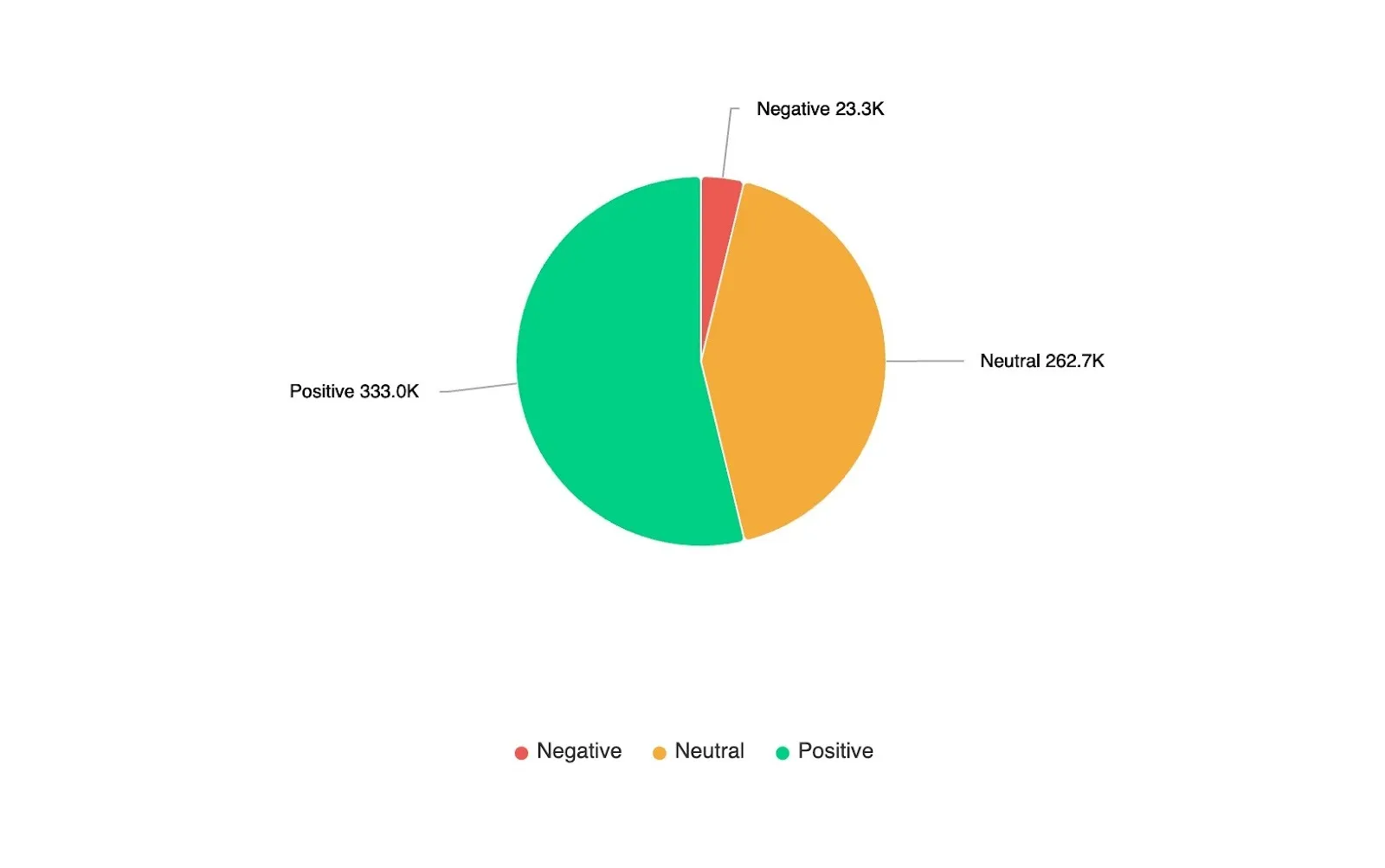
To stay ahead of viral volatility, your strategy has to catch weak signals early, especially in places like Reddit and niche forums where crises often incubate before they hit the mainstream. But volume alone won’t save you as a spike can be harmless chatter. What matters is sentiment velocity, essentially how fast negative emotion is accelerating, and whether it’s starting to tip the conversation from noise into threat.
When you wire those insights into your workflow through automated alerts, you cut through silos. The right people see the signal instantly, instead of it getting stuck in one team’s inbox until it’s too late.
The 4-Step Framework for a Signal-Based Crisis Playbook
Step 1: Automated Signal Intake and Threat Triage
Effective response begins when we replace manual monitoring with automated signal intake and threat triage. By utilizing AI to scan for keywords, sentiment spikes, and cross-platform mentions within videos, posts or comments, you can categorize a potential crisis by its severity almost instantly after it appears. This ensures that the noise is filtered out and the team is only alerted to high-velocity threats that require immediate action.
Step 2: Activating Incident Playbooks for Containment
Once a threat is verified, the priority shifts fast, containing the issue and stopping the narrative from escalating. This is where speed matters. You don’t want to waste precious minutes getting the right people in a room or waiting for approvals to start moving. Your system should trigger a pre-approved playbook tailored to the incident type, so the first steps happen immediately.That includes deploying a holding statement and automatically pausing scheduled marketing. It buys your team time to investigate, align internally, and craft the full response, without the crisis gaining momentum while you scramble.
Step 3: Synchronizing Messaging via a Virtual Command Center
With containment underway, you must focus on synchronizing messaging via a virtual command center to ensure both internal and external alignment. The command center acts as a single source of truth where legal, PR, and executive teams can collaborate in real-time. This synchronization ensures that a video message, a tweet, a press release, even an internal company memo, all deliver a consistent, unified message that prevents public confusion.
Step 4: Using Post-Mortems to Rebuild Stakeholder Trust
The final phase of analyzing the data behind the event rebuilds stakeholder trust. By reviewing the timeline of the real-time crisis response, you can provide transparent, data-backed reports to your clients - from senior-level executives to board members. This reverse-engineering process identifies where the playbook succeeded and where it needs refinement for better resilience in the future.
The dig tip:
To avoid burnout, set your alerts to only trigger a full incident response playbook if a digital signal sustains velocity for 15 minutes. This filters out temporary noise and ensures your team only responds to high-probability threats.
Using AI to Automate Your Crisis Response Strategy
Stress-Testing Plans with AI "Black Swan" Simulations
Traditional tabletop exercises are often too predictable to be effective. By using generative AI to run "Black Swan" simulations (that is, simulating an extremely rare and unpredictable high-impact event), teams can pressure-test their crisis communications playbook against highly improbable yet high-impact scenarios. These AI-driven drills generate realistic social media firestorms and adversarial press inquiries in real-time, allowing the team to identify any technical triggers or gaps in the pre-planned protocol before a real crisis occurs.
Narrative Detection: Identifying the Story Before It Escalates:
Most crises don’t start as crises. They start as a story. A few clips land, the comments agree on a single takeaway, and that framing spreads like wildfire through stitches, duets, reposts, and memes. Once it solidifies, you’re no longer correcting facts. You’re fighting belief.
Narrative detection is how you catch that story early, while it’s still forming. AI can spot the repeated themes and emotional hooks, trace which videos are fueling the spread, and identify the accounts driving it. It can also flag suspicious amplification, like bot profiles or coordinated inauthentic accounts pushing the same talking points. That’s the difference between stepping in early and scrambling once it’s everywhere.
Scaling Executive Briefings with AI Sentiment Summaries
During a live incident, manual reporting is a bottleneck that delays decisive action. AI-powered sentiment summarization transforms thousands of data points into concise, high-level executive briefings. Instead of sifting through raw mentions, leadership receives an instant analysis of narrative shifts, stakeholder intent, and response effectiveness. This ensures that the C-suite remains informed without distracting the tactical team from their containment efforts.
High-Profile Moments: Why Every Major Campaign Needs a Crisis Playbook
AI-Slop? AI-Stop.
High-profile moments make one thing brutally clear: if you don’t have a crisis playbook before a launch, the internet will write one for you. In a real-time feed, you don’t need a full-blown scandal to lose control. A few negative narratives can spread fast, derail momentum, and reshape perception before your campaign even scales.
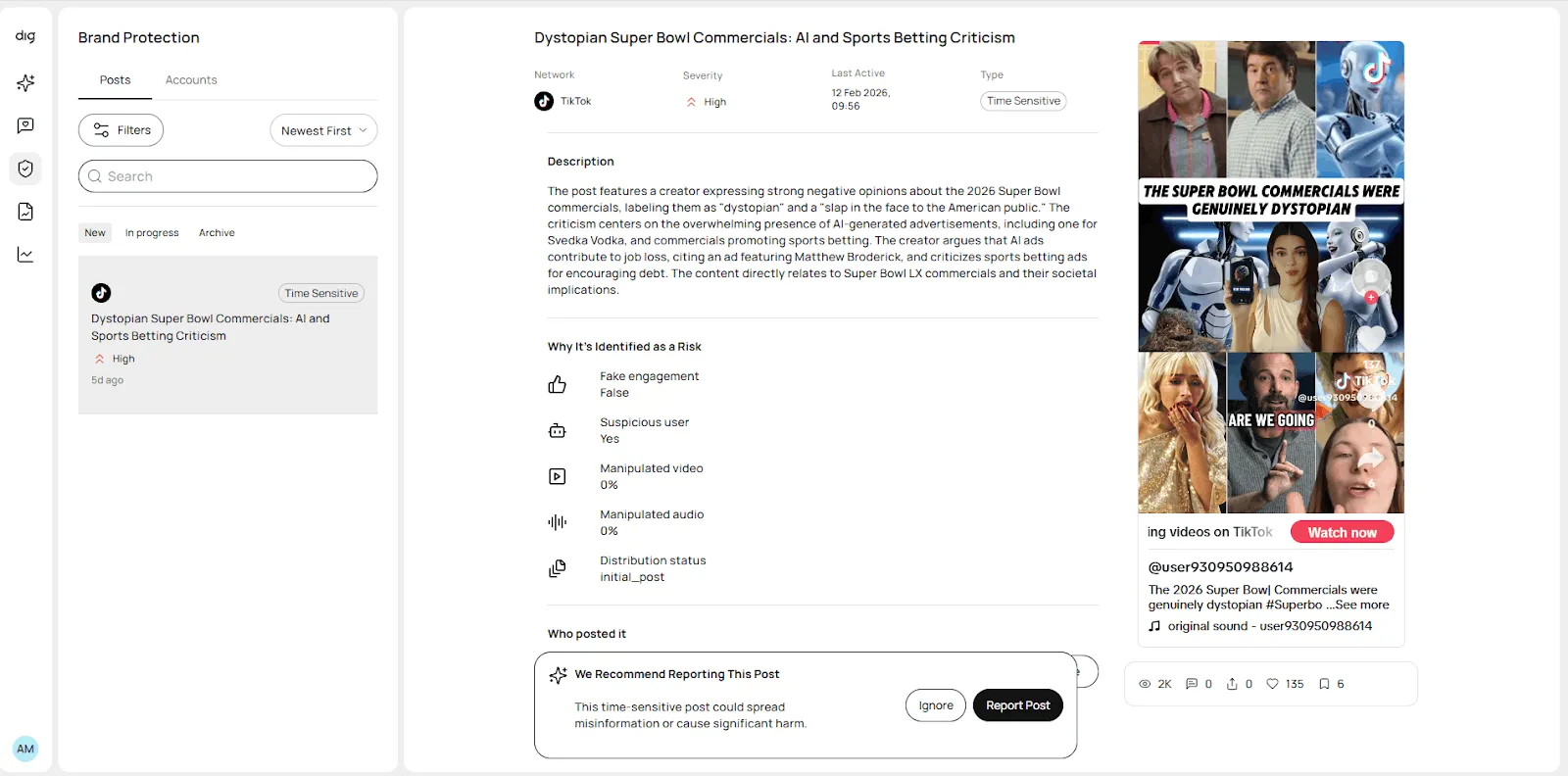
The Super Bowl is the best example. In 2026, several brands leaned into AI without fully pressure-testing how it would land. Dunkin’ went for nostalgia with digitally de-aged celebrity cameos. Technically impressive, but it sparked a wave of reaction videos calling it uncanny and inauthentic. The real risk wasn’t the creative choice. It was the narrative vacuum. Super Bowl reach doesn’t just amplify awareness, it amplifies scrutiny. And once reactions start defining the story, you lose the luxury of time.
AI-Gen? Think Again.
Svedka’s AI-heavy Super Bowl spot ran into a similar dynamic. Some viewers read it as a hollow stunt, and the commentary reframed the campaign within hours. This is exactly where a crisis playbook earns its keep. Controversial creative isn’t the problem. Being unprepared is.
When backlash hits, the goal is to act in the first hour: acknowledge what’s happening, clarify the facts, align internal stakeholders on one message, and pause scheduled marketing before the narrative locks in. Then you earn back the right to tell your story.
Marketing today comes with an unfair expectation: predict the reaction before it happens. You can’t. But you can be ready for the negative version of the outcome, and respond at internet speed the moment the story starts turning.
Real-Time Backlash Playbook for Any Campaign
- Track the comment pulse: Monitor comments and reaction videos to see what people are actually reacting to, and which frames are spreading fastest.
- Name what’s driving it: Is the criticism about the creative, the product, ethics, misinformation, or brand values .and who’s amplifying it
- Acknowledge fast: Don’t disappear. Address the concern publicly, set expectations on what you’re checking, and buy time without sounding defensive.
- Choose the move: Clarify with context, correct false claims, adjust the campaign, pause and reset, or pivot the narrative with new content.
But high-stakes reputational risk isn’t limited to moments like the Super Bowl. One global brand recently faced a wave of online disinformation fueled by misleading competitor claims about its product. By analyzing social video directly, the team could track not just text mentions, but what was being said inside the videos and what viewers were being shown visually, the cues that were actually shaping perception. Catching the narrative early gave them the time to trigger their crisis playbook, contain the spread, and prevent the story from scaling.
Once brands can see what’s being said and shown across social, they can make faster, clearer decisions, and de-escalate before momentum takes over.
From Blindspots to a Full View
Blind spots are expensive. A campaign can look perfect on paper, then get torn apart in the comments within minutes. That reaction loop is the market now, telling you, in real time, whether you built trust or triggered doubt.
And the risk isn’t only organic. Competitors and bad actors can push misleading narratives, half-truths, and manufactured controversy that spreads faster than your internal alignment.
That’s why monitoring can’t stop at text mentions. You need to see what’s being said and shown inside social video. When you can track the full signal as it forms, you can catch reputational risk early, respond with clarity, and shut it down before it scales.
The dig tip:
Real-time monitoring isn’t optional anymore. When you can see what’s happening inside social video, track sentiment and visual context, and catch disinformation early, you can respond while the story is still forming. That’s why the crisis playbook has to be ready before launch, not built in the middle of the backlash.
How dig.ai Powers Your Real-Time Crisis Communications and Incident Response
Executing a real-time crisis communications playbook requires infrastructure that can track and analyze signals at internet speed. dig becomes your social media crisis response hub, automating the most critical phases of your incident management protocol:
Signal Ingestion: Consolidate Global Alerts into One View
The platform eliminates tool sprawl by aggregating data from across the social and forums into a single, unified dashboard. This single source of truth ensures your team isn't jumping between apps or docs while a crisis scales.
AI Triage: Automated Severity and Sentiment Scoring
Not every mention is a threat. dig.ai uses proprietary AI to instantly analyze the sentiment velocity and reach of a signal, automatically assigning a severity score. This allows you to focus resources on genuine brand risks and filter the noise.
Living Playbooks: Dynamic Templates That Adapt to Data
Static PDFs are replaced with living playbooks that adapt as new data emerges. If an incident shifts scope, for example, from product concern to legal risk, the system recommends response workflows and updated task lists for the relevant departments.
Executive Visibility: Instant AI Briefings for Leadership
During a live incident, manual reporting becomes a bottleneck. dig.ai automatically generates concise, data-backed executive briefings that summarize sentiment trends, narrative shifts, and response status. Leadership stays aligned without pulling the tactical team away from containment efforts.
Is Your Crisis Management Team Ready for 2026?
Modern crises unfold in minutes, not days. To see if you’re truly prepared, ask yourself one question: does your crisis communications playbook enable real-time action, or does it just sit in a document?
Your team is likely ready if:
- You can detect emerging threats within minutes, using integrated social media listening across videos, posts, comments and news articles - and aren’t forced to wait for scheduled monitoring reports.
- Your incident response playbook defines clear operational roles (e.g., Incident Commander, Communications Lead, Signal Analyst) so decisions aren’t stalled or stuck in dead-end approval chains.
- Your monitoring tools and communication platforms share a single source of truth, ensuring leadership, legal, and communication teams all see the same real-time data.
- You have predefined escalation thresholds (such as sentiment velocity or reach spikes) that trigger action automatically.
- Your team regularly runs realistic crisis simulations, testing how quickly signals turn into coordinated responses.
If any of these capabilities depend on manual processes or disconnected tools, your organization may be operating with a delayed “time to clarity”, thus increasing the risk that a small negative sentiment will become a full-scale reputational event before your team can act.
Don’t wait. Remember:
- Tracking harmful narratives: Crisis playbooks are only as good as their data.
- Speed via automation: Use real-time crisis response triggers.
- Unified control: Align all teams with your incident response playbook.
- Monitor velocity: Track sentiment speed, not just volume.
Frequently Asked Questions about the signal-based crisis playbook (FAQ):
What is a signal-based crisis playbook?
A signal-based crisis playbook is a dynamic response plan triggered by real-time data rather than manual observation. Unlike traditional static plans, it uses social media listening and AI to detect sentiment velocity thresholds, automatically activating pre-approved workflows, alert chains, and containment strategies the moment a threat is verified.
How does AI improve crisis response times?
AI improves response times by automating the "Golden Hour" tasks that typically cause bottlenecks. It performs automated threat triage to filter noise from real risks, generates instant executive briefings through sentiment summarization, and triggers immediate stakeholder notifications, allowing teams to move from detection to action in under 15 minutes.
What is Time to Clarity (TTCl) in crisis management?
Time to Clarity (TTCl) is a performance metric that measures the duration between the first digital signal of an incident and the moment leadership has enough analyzed data to make an informed decision. Reducing TTCl is the primary goal of a modern incident response playbook, as it minimizes the window of uncertainty where brand reputation is most vulnerable.
How do you automate a crisis communications template?
You can automate a crisis communications template by integrating your monitoring tools with a digital command plane like dig.ai. For example, a rapid increase in negative sentiment can automatically alert stakeholders, populate approved messaging templates, and initiate the appropriate response protocol.

Related stories
.png)
.png)
.png)